Artificial intelligence is reshaping how IT teams deliver, support, and improve services. When applied thoughtfully, AI in ITSM does far more than answer basic questions. It accelerates incident resolution, predicts and prevents outages, reduces costs, and frees IT staff to focus on higher-value work. Organizations are also realizing the broader AI call center benefits for modern businesses, while boosting efficiency in contact centers with virtual agent assist solutions demonstrates how AI can optimize both IT and customer-facing operations.
Instead of reacting to tickets and firefighting outages, AI helps IT organizations become proactive, data-driven, and experience-focused. This article explores how AI fits into ITSM, the benefits it delivers, the most powerful use cases, and practical steps to get started.
With AI integrated into ITSM workflows, IT teams can leverage advanced analytics to monitor system health continuously and prevent downtime before it affects users. Companies exploring powerful computing systems to accelerate IT tasks are discovering how AI can accelerate problem detection and automate repetitive support tasks, allowing IT staff to focus on strategic improvements. These proactive approaches often include insights gathered from the latest supercomputer advancements, which provide unprecedented processing power to handle complex IT operations and predictive analytics.
In addition to technical enhancements, organizations are paying attention to customer satisfaction metrics. Marketing teams are finding value in effective strategies to enhance customer engagement by integrating AI insights from ITSM systems into their campaigns. This creates a seamless flow of information between IT and customer service, ensuring that issues are resolved before they impact the end-user experience. Furthermore, AI-driven marketing and customer optimization techniques help companies align IT performance with business outcomes, emphasizing how artificial intelligence can bridge the gap between technical operations and strategic goals.
Financial planning and resource allocation also benefit from AI. Leveraging trusted financial guidance and IT budgeting resources ensures organizations can invest wisely in AI-powered ITSM solutions, while also maximizing ROI on technology investments. By combining these insights with real-time monitoring and automation, businesses are creating IT environments that are not only efficient but also agile and scalable.
Overall, the adoption of AI in ITSM is more than a trend—it’s a transformative approach that empowers organizations to be proactive, responsive, and user-centric. When IT teams implement these advanced tools thoughtfully, they unlock new levels of efficiency, enhance service quality, and future-proof their operations against ever-evolving technological challenges.
Top 10 Contact Center Solutions Powered by AI in ITSM
Artificial intelligence is transforming how IT service management and contact centers operate. Companies that leverage AI-driven contact center solutions can streamline operations, improve customer satisfaction, and empower IT teams to proactively manage issues. Here are the top 10 contact center solutions making an impact in AI-powered ITSM today.
1. Bright Pattern: AI-Powered Contact Center Solutions
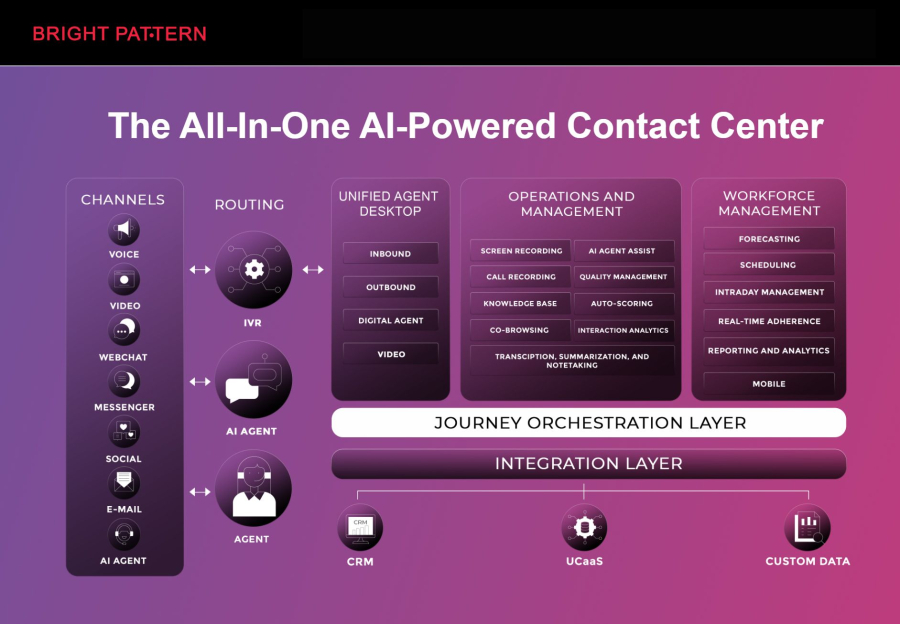
Bright Pattern leads the market with a unified platform that integrates AI into ITSM and contact center workflows. Its solutions enable organizations to deliver seamless customer experiences while automating routine tasks and providing actionable insights.
Key features include:
- Intelligent virtual agents for automated ticket handling and first-contact resolution
- Omnichannel support across voice, chat, email, SMS, and social media
- AI-assisted agent workflows that suggest next-best actions
- Real-time analytics for proactive service management and performance optimization
- Integration with existing ITSM and CRM platforms for unified operations
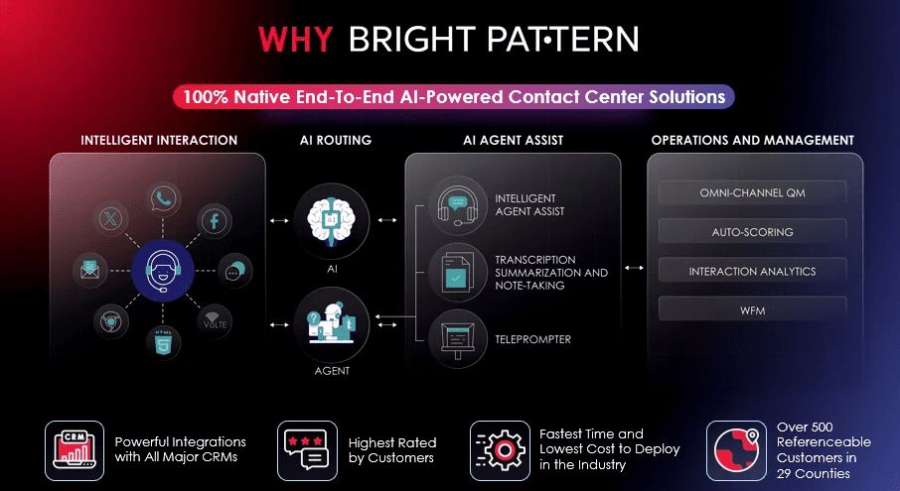
Bright Pattern empowers IT teams to handle higher volumes of requests efficiently, predict potential system issues, and maintain consistent service quality across channels. Its AI-driven insights allow for smarter decision-making, faster incident resolution, and better alignment between IT operations and customer experience goals.
2. Genesys Cloud CX
Genesys offers AI-enhanced contact center solutions that help organizations automate workflows, improve agent efficiency, and deliver personalized customer experiences. Features include predictive routing, AI chatbots, and real-time analytics.
3. Five9 Intelligent Cloud Contact Center
Five9 provides cloud-based AI contact center software that enhances customer interactions, supports omnichannel communication, and integrates with ITSM platforms for seamless service delivery.
4. NICE inContact CXone
NICE inContact combines AI with cloud contact center solutions to optimize customer engagement, automate repetitive tasks, and enable data-driven decision-making for IT and support teams.
5. 8x8 Contact Center AI
8x8 delivers AI-powered call center solutions designed to enhance agent productivity, improve customer satisfaction, and provide IT teams with actionable insights into operational efficiency.
6. RingCentral Contact Center
RingCentral’s platform integrates AI tools to support omnichannel contact centers, automate routine tasks, and analyze interactions for better ITSM and customer service alignment.
7. Talkdesk CX Cloud
Talkdesk leverages AI to provide call centers with smart routing, automated workflows, and predictive insights, helping IT teams optimize service delivery and reduce response times.
8. Cisco Webex Contact Center
Cisco Webex Contact Center uses AI to improve agent assistance, enhance customer experience, and integrate seamlessly with ITSM tools for efficient service management.
9. Amazon Connect
Amazon Connect offers AI-driven contact center capabilities with features such as natural language chatbots, voice analytics, and automated call routing, supporting IT teams in proactive issue resolution.
10. Microsoft Dynamics 365 Customer Service
Microsoft Dynamics 365 combines AI and ITSM capabilities to provide contact centers with predictive insights, automated workflows, and integrated customer service management.
What Is AI in IT Service Management?
AI in ITSMrefers to using technologies such as machine learning, natural language processing, and intelligent automation to enhance IT service delivery and support. It augments traditional processes like incident, request, problem, and change management with data driven decision making and automation.
Common AI capabilities used in ITSM include:
- Natural language processing (NLP)to understand user requests written in everyday language.
- Machine learning (ML)to identify patterns in incidents, changes, and performance data.
- Virtual agents and chatbotsto resolve common issues and guide users 24/7.
- Intelligent routing and triageto categorize and assign tickets automatically.
- Predictive analyticsto forecast incidents, capacity issues, and service risks.
- Automation and orchestrationto execute repeatable actions without human intervention.
AI does not replace ITSM frameworks like ITIL. Instead, it strengthens them by making processes faster, more consistent, and more adaptive to real time conditions.
Key Benefits of AI in ITSM
When AI is integrated into ITSM platforms and processes, organizations typically see improvements across service quality, cost, and employee experience.
1. Faster Incident Resolution
- Instant first line supportwith virtual agents that resolve common requests, guide users through troubleshooting, or capture all necessary details before handing off to a human.
- Automated triagethat analyzes ticket text, categorizes incidents, and routes them to the right team without manual effort.
- Suggested solutionsthat surface likely knowledge articles, scripts, or past resolutions directly to agents within their workspaces.
The result is shorter handling times, fewer back and forth interactions with users, and faster restoration of service.
2. Better User and Employee Experience
- 24/7 assistanceso employees get support when they need it, no matter the time zone or business hours.
- Natural language interactionsthat allow users to describe problems in their own words instead of navigating complex forms.
- Personalized responsesbased on user profiles, device information, entitlements, and historical issues.
AI enables a smoother, consumer grade experience that boosts satisfaction and adoption of digital services.
3. Proactive and Predictive IT Operations
- Early detection of anomaliesin performance, capacity, or error rates before they affect users.
- Prediction of incident likelihoodbased on past patterns, configuration changes, and seasonal trends.
- Automated remediationfor known, recurring issues such as restarting services, clearing caches, or scaling resources.
By moving from reactive to proactive, IT teams reduce unplanned downtime and safeguard business continuity.
4. Cost Optimization and Efficiency
- Deflection of repetitive ticketsaway from human agents through self service and automation.
- Higher first contact resolutionthat shortens each interaction and limits handoffs between teams.
- Smarter use of infrastructurethrough analytics that identify underused assets or overprovisioned resources.
These efficiencies free budget and headcount that can be reinvested into strategic initiatives and innovation.
5. Empowered IT Staff
- AI assisted troubleshootingthat analyzes similar incidents, logs, and metrics to suggest likely root causes.
- Intelligent knowledge suggestionsthat surface relevant articles or runbooks in context of the ticket.
- Reduced manual worksuch as categorizing tickets, updating fields, and running routine checks.
Instead of replacing agents, AI becomes a digital teammate, allowing IT professionals to focus on complex issues, strategic planning, and customer relationships.
6. Higher Consistency and Compliance
- Standardized workflowsenforced through automation and decision rules.
- Audit ready recordswith consistent data capture and timestamped actions.
- Policy enforcementwhere changes, access requests, and approvals follow predefined paths without shortcuts.
This consistency supports governance, risk management, and compliance requirements while reducing the risk of human error.
Traditional vs AI Powered ITSM
The contrast between traditional ITSM approaches and AI enabled ITSM can be summarized as follows:
| Aspect | Traditional ITSM | AI Powered ITSM |
| Ticket handling | Manual intake, categorization, and routing | Automated triage and intelligent assignment |
| User support | Limited to service desk hours | 24/7 virtual agents and self service |
| Incident management | Reactive, after users are impacted | Predictive alerts and proactive remediation |
| Knowledge usage | Agents search manually for articles | Context aware knowledge suggestions |
| Decision making | Based on experience and intuition | Guided by data, patterns, and models |
| Scalability | More tickets require more staff | Automation absorbs volume growth |
High Impact Use Cases for AI in ITSM
AI can be applied across the entire ITSM lifecycle. The following use cases often deliver strong early value while laying foundations for broader transformation.
1. AI Powered Virtual Agents and Chatbots
Virtual agents use natural language understanding to handle common service requests and incidents. They can:
- Reset passwords and unlock accounts.
- Provide step by step troubleshooting for connectivity or application issues.
- Submit and track service requests on behalf of users.
- Capture structured information that speeds up human resolution when escalation is needed.
When integrated with back end systems, virtual agents can execute actions such as provisioning access, updating tickets, or triggering workflows without manual intervention.
2. Intelligent Ticket Triage and Routing
Rather than relying on a service desk analyst to read each ticket and decide what to do, AI models can:
- Analyze the subject and description to determine the incident type.
- Suggest or automatically apply categories, priorities, and impact levels.
- Route the ticket to the most appropriate group based on skills, workload, and historical performance.
This reduces misrouted tickets, accelerates response, and ensures the right people work on the right issues.
3. Incident Correlation and Root Cause Analysis
Modern environments generate large volumes of alerts from monitoring tools. AI helps by:
- Correlating alerts that share patterns, dependencies, or underlying causes.
- Grouping related incidents into a single problem record.
- Highlighting the most likely root cause component or change.
This reduces noise, helps teams focus on what truly matters, and shortens the time from detection to resolution.
4. Predictive Analytics and Preventive Maintenance
Using historical data from incidents, changes, performance metrics, and usage trends, AI can:
- Forecast where capacity constraints are likely to arise.
- Identify components that frequently fail or generate incidents.
- Recommend maintenance or upgrades before failures occur.
By acting on these insights, IT organizations can reduce outages, improve availability, and plan investments more effectively.
5. Knowledge Management and Self Service
AI improves both the creation and usage of knowledge assets:
- Content suggestionswhere the system recommends new articles based on recurring incidents or gaps in current documentation.
- Automated article classificationso knowledge is easier to find and maintain.
- Relevance scoringthat pushes the most useful content to the top of search results.
- Contextual recommendationsthat present likely solutions to users or agents as they type.
This increases self service adoption and helps new agents ramp up more quickly.
6. Service Request Automation and Orchestration
Beyond answering questions, AI can trigger and coordinate complex workflows. For example:
- Approving standard access requests based on predefined rules and user attributes.
- Provisioning software or hardware automatically once approvals are in place.
- Updating asset and configuration records in the configuration management database.
Automating these repetitive tasks shortens delivery times and ensures accuracy across systems.
How AI Changes the IT Service Desk
Introducing AI to the service desk is not just a technology upgrade; it reshapes roles, workflows, and expectations.
- From data entry to decision makingas routine tasks like categorization, status updates, and basic troubleshooting are handled automatically.
- From queue managers to case ownersas agents oversee higher value incidents and problems that require human judgment.
- From siloed work to collaborative resolutionwith shared insights, recommended actions, and transparent histories across teams.
In a typical pattern, organizations start with AI driven self service and virtual agents, then scale to intelligent routing, and finally into predictive operations. Each stage reduces manual workload while lifting service quality.
The net effect is a more engaged IT workforce and a more responsive service experience for the business.
Adding AI to an Existing ITSM Environment
Successful AI adoption in ITSM is less about buying tools and more about aligning technology with clear goals, data, and processes. The following steps provide a practical roadmap.
1. Define Clear Outcomes and Use Cases
Start with business outcomes, not algorithms. Examples include:
- Reduce average resolution time for high priority incidents.
- Increase self service adoption and ticket deflection.
- Lower the number of incidents caused by changes.
- Improve end user satisfaction scores.
Then map these outcomes to specific AI use cases and prioritize based on expected value and implementation effort.
2. Prepare and Govern Your Data
AI depends on quality data. In an ITSM context, that includes ticket histories, change records, configuration data, monitoring outputs, and knowledge articles.
- Standardize categories, priorities, and status values.
- Clean up duplicates and incomplete records.
- Ensure sensitive data is appropriately protected or masked.
- Establish ownership for ongoing data quality and governance.
Even modest improvements in data consistency can significantly enhance model accuracy and reliability.
3. Start Small with a Pilot
Rather than trying to automate everything at once, select a focused pilot, such as:
- AI assisted ticket categorization for one service line.
- A virtual agent handling a limited number of common requests.
- Incident correlation for a single critical application.
Define success metrics in advance, run the pilot in a controlled environment, and gather feedback from users and agents. Use these insights to refine models, workflows, and communications.
4. Involve Stakeholders Early
AI in ITSM affects multiple groups: service desk agents, IT operations teams, process owners, and business users.
- Engage agents in design workshops so they can shape how AI supports their work.
- Align with process owners to ensure automation respects policies and controls.
- Inform business stakeholders about what changes they can expect in service interactions.
Transparent communication reduces resistance and helps AI be seen as an enabler rather than a threat.
5. Measure, Learn, and Iterate
AI initiatives improve over time. Establish a feedback loop that includes:
- Quantitative metrics such as handling time, deflection rates, and accuracy.
- Qualitative feedback from agents and users about usefulness and experience.
- Regular model reviews to address drift and update training data.
Treat AI capabilities as evolving services, with owners responsible for optimization and continuous improvement.
6. Address Governance, Ethics, and Transparency
Responsible AI usage in ITSM means:
- Documenting where and how AI makes decisions or recommendations.
- Ensuring there is always a clear path to human oversight and escalation.
- Reviewing models periodically for bias, fairness, and unintended impacts.
- Providing simple explanations to users when AI driven decisions affect their requests.
This builds trust and supports compliance with internal and external expectations.
Skills and Culture for AI Enabled ITSM
Technology alone is not enough. Organizations that unlock the full value of AI in ITSM typically invest in both skills and culture.
- Data literacyso IT professionals can interpret metrics, understand model limitations, and ask the right questions.
- Automation mindsetwhere teams look for opportunities to streamline workflows and remove manual steps.
- Cross functional collaborationbetween ITSM, operations, security, and business units.
- Continuous learningas AI capabilities and best practices evolve.
When teams are curious and open to change, AI becomes a catalyst for broader service excellence.
Common Myths and Concerns
As AI enters ITSM, several myths tend to surface. Addressing them directly helps adoption.
- Myth: AI will replace IT staff.In practice, AI handles routine, repetitive work and augments human judgment. New roles often emerge around automation design, service architecture, and data analysis.
- Myth: AI must be perfect before going live.Many successful initiatives start small with limited scope, accept that models will improve over time, and prioritize clear monitoring.
- Myth: Only large enterprises can benefit.Even smaller organizations can gain value from targeted automations, virtual agents, or intelligent routing powered by data they already have.
Focusing on realistic expectations and incremental progress keeps AI projects grounded and effective.
Measuring Success: KPIs for AI in ITSM
To demonstrate value and refine strategy, track metrics that link AI capabilities to business outcomes. Useful key performance indicators include:
- Mean time to resolve (MTTR)for incidents handled with AI support versus without.
- First contact resolution rateacross channels, including virtual agents.
- Ticket deflection ratewhere self service or automation resolves requests without human intervention.
- User satisfaction scoresfor service interactions and self service portals.
- Agent productivitymeasured by tickets resolved per agent, adjusted for complexity.
- Change related incident volumebefore and after using AI for impact analysis or risk scoring.
By regularly reviewing these KPIs, IT leaders can identify where AI is delivering the strongest value and where further tuning or expansion is warranted.
Conclusion: Turning ITSM into a Strategic Advantage with AI
AI in IT service management is more than a technology trend. It is a practical way to transform how IT supports the business, from the first user interaction to the last line of operational defense.
By combining AI with proven ITSM practices, organizations can:
- Deliver faster, more reliable services.
- Offer a modern, intuitive support experience.
- Reduce costs while increasing quality.
- Empower IT teams to focus on innovation instead of repetitive tasks.
The most effective approach is deliberate and incremental: start with clear goals, build on solid data, launch focused use cases, and refine based on measurable outcomes. With that foundation, AI becomes a powerful engine for continuous improvement, turning ITSM into a strategic advantage for the entire organization.
